 Stolen Reps
Workout program vs. workout generator: which survives a real week?
Quick answer: a program is a curriculum — a coach writes five or six weeks of sessions in advance, and you follow them. A generator builds today's session from today's constraints. Programs are better when your schedule is stable and you want someone else's expertise driving the bus. Generators are better when the length of your training window changes without warning, because a session written six weeks ago cannot know you only got twenty minutes today. Stolen Reps is a generator.
The thing a program can't know
Every written program makes one quiet assumption: that you can train on its terms. It assumes a session length — usually 45 to 60 minutes — because the coach had to pick one when they wrote it. That assumption is invisible while your week cooperates, and it is the entire problem when it doesn't.
Good program apps handle equipment gaps well. If the plan says cable fly and you own dumbbells, a coach's note offers a swap. That's a real feature and it works. But swapping a movement doesn't change how long the session takes. When the honest answer to "how long have you got" is 22 minutes, starting now, a movement swap doesn't help — you need a different session, not a substituted one.
Where programs genuinely win
This isn't a case that programs are bad, and you should be suspicious of anyone who tells you otherwise. Programs beat generators at three real things:
- Editorial judgment. A named coach making deliberate choices across six weeks will out-think a rules engine on nuance, every time.
- Accountability. A team, a chat, a coach expecting you on Thursday — that is a genuine reason to show up, and no algorithm replaces it.
- Not deciding. Some people want the thinking removed entirely. "Do today's workout" is a real feature if your schedule supports it.
If your week is predictable and you want a coach's voice in your ear, buy a program. It's the right tool and it costs about five times what this app does, for reasons.
What a generator does instead
The trade is that you give up a named coach's curriculum and get a session shaped around the three things that actually vary day to day:
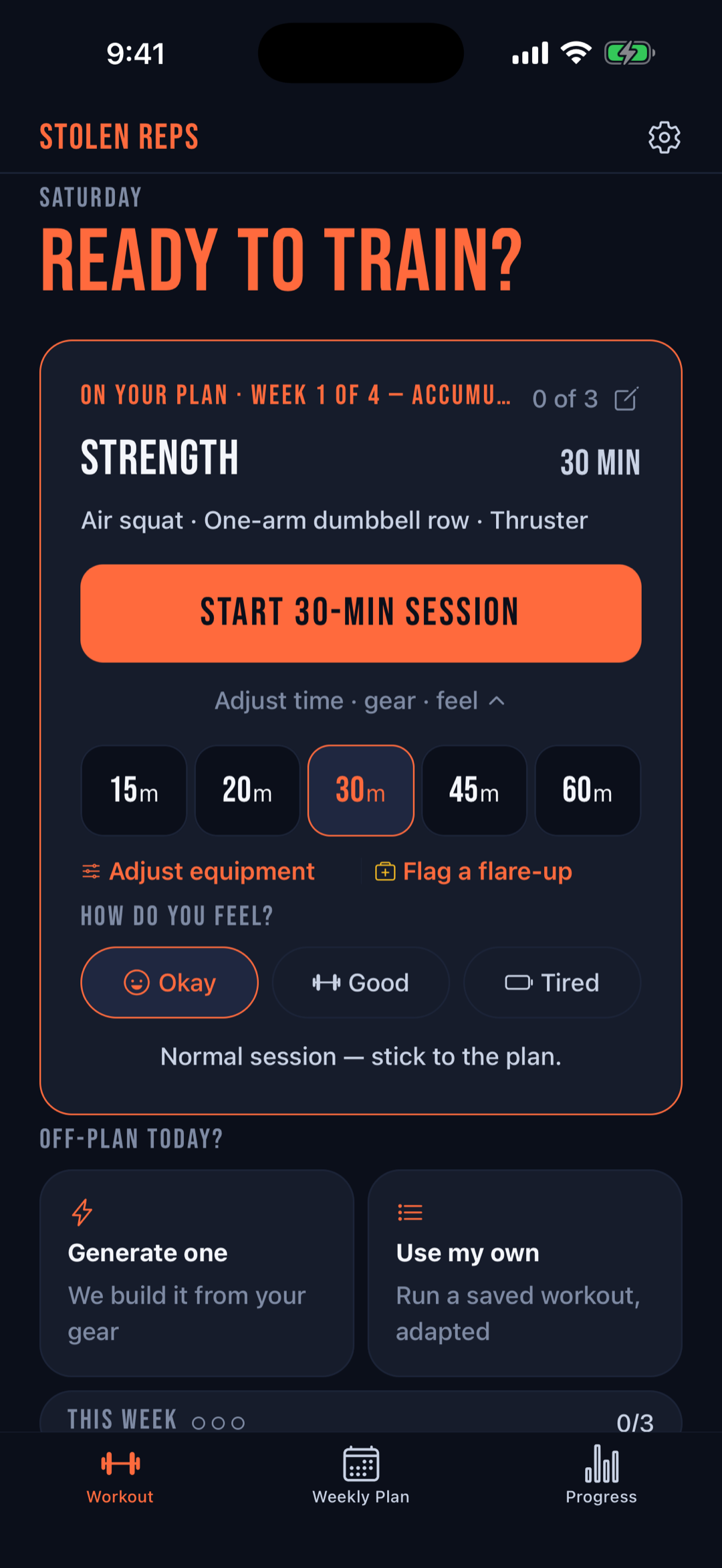
- Time is an input, not an assumption. 15, 20, 30, 45 or 60 minutes. The session isn't a 45-minute plan with things crossed out — the whole structure, including how long you rest between heavy sets, is built for the window you gave it.
- Gear is an input. Bodyweight in a hotel room, two dumbbells in a garage, a full rack. It only prescribes what you can actually load.
- Your body is an input. Flag a sore knee and the moves that load it are swapped out, not annotated. Six training styles, 190+ curated exercises to draw from.
The part people get wrong about structure
"Generated" sounds like "random," and that's the fair objection. It isn't the same thing. Underneath, sessions still follow a shape: heavy compound work first, accessories after, a short core block to close. Rest between sets is tiered by how taxing the lift is rather than a flat number. Lifts alternate across sessions so you're not benching three times in a row. There's a weekly plan and a four-week progression running underneath the whole thing.
The structure is real. What changes is that it gets rebuilt against today's constraints instead of being written in advance and hoping today cooperates.
How to pick, honestly
- Your training window is the same most days → a program will probably serve you better.
- You want a coach and a team → definitely a program. This app has neither and won't.
- You know what you're doing but not when you'll get to do it → a generator. This is the case Stolen Reps was built for.
- You keep abandoning plans after a bad week → a generator, because there's nothing to fall behind on. The week counts what you did, not what you owed.
Related: the flexible weekly plan · generating by equipment · the 20-minute dumbbell session.