 Stolen Reps
Workout generator by equipment: build a session from exactly what you own
Quick answer: an equipment-based workout generator asks what gear you have (dumbbells, kettlebell, barbell + rack, bands, a pull-up bar, machines, or nothing) and programs a complete session using only that. In Stolen Reps, check your gear once in Settings and every generated workout, plan session, and adaptation respects it automatically.
Why generic programs fail at home
Most workout programs quietly assume a commercial gym: leg press here, cable row there. Follow one at home and you're constantly substituting on the fly, which usually means skipping the hard lifts or doing a worse version of the workout. The fix is inverting the order: start from the equipment, then build the program.
What good equipment-aware generation looks like
- Any-of vs all-of logic. A goblet squat needs a dumbbell or kettlebell. A back squat needs a barbell and a rack. A generator that doesn't model the difference will prescribe lifts you literally can't set up. Stolen Reps gates every exercise with this AND-logic.
- Pattern coverage from any gear. Whatever you own, a balanced session still needs a squat, a hinge, a push, and a pull. With bands only, that might be band pulldowns; with a rack, it's the real thing.
- Honest fallbacks. No equipment at all should produce hard bodyweight progressions, like pike push-ups, tempo squats, Nordic curls, not endless air squats.
- Today ≠ every day. Your default gear lives in your profile, but traveling? One tap swaps today's session to hotel-room equipment without touching the plan.
How to do it in Stolen Reps
- Settings → Home Equipment. Check off what you own, from bodyweight-only to barbell, squat rack, bench, kettlebells, bands, machines, sleds and ergs.
- Generate. Pick time + training style; the session is built from your gear with proper warm-up, paired main lifts, and a core finisher.
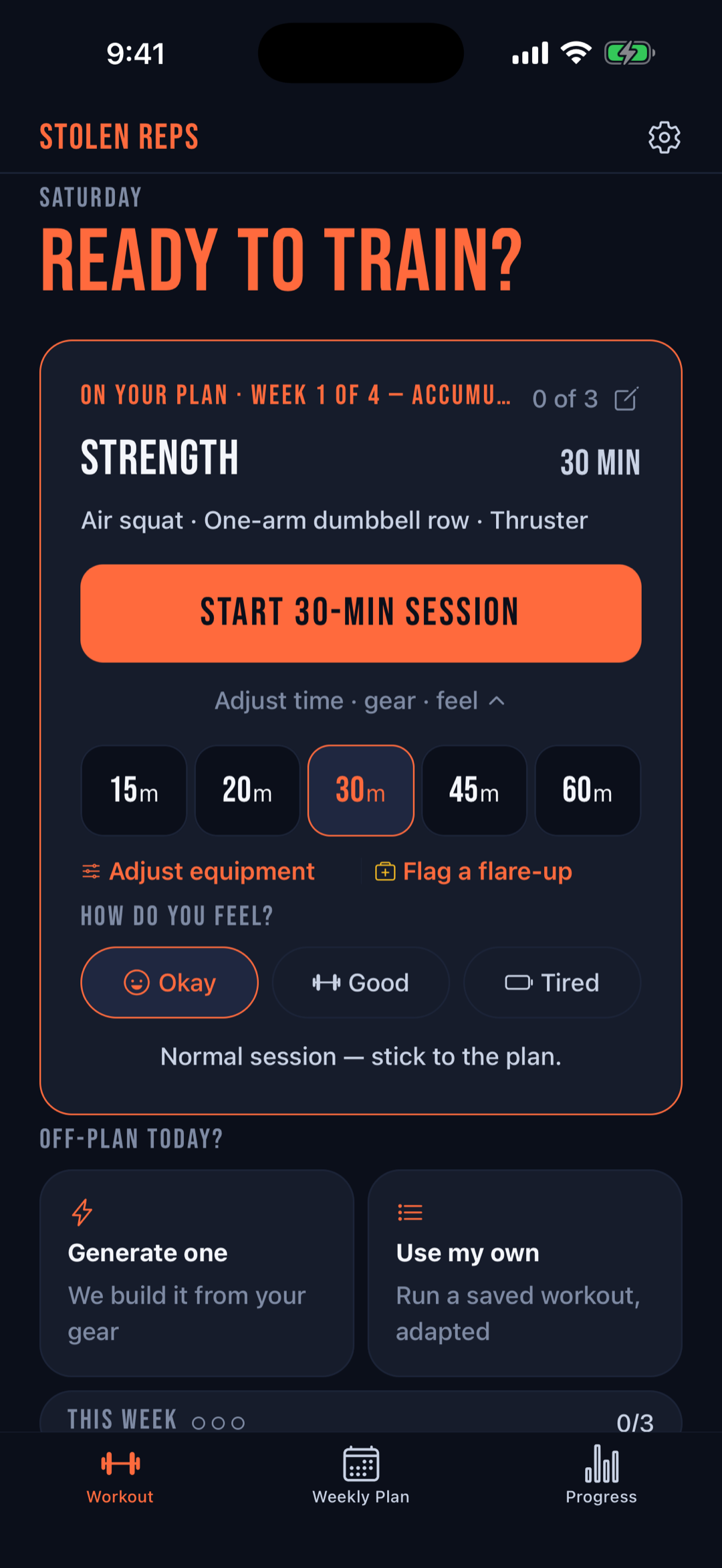
- Override per session. On the home screen, "Adjust time · gear · feel" changes today's equipment (garage vs. living room vs. hotel) without changing your defaults.
- Swap any single move. Don't like a pick? The variations sheet offers alternatives that still fit your equipment and muscle target.
What a good session looks like from each equipment tier
"Build from my equipment" only helps if the result is actually a complete session, not a random pile of moves the filter happened to allow. A good generator still covers the four movement patterns your body works through — a squat, a hinge, a push, a pull — plus a little core and conditioning, using whatever you own to express each one. Here is what that looks like tier by tier, and how Stolen Reps' AND-logic gating keeps each session honest.
Bodyweight only
With nothing on hand, the constraint isn't the pattern, it's the load. A weak generator fills the gap with volume — 50 air squats, 40 sit-ups — which is boring and stops challenging you fast. A good one reaches for harder progressions: push-up variations and pike or elevated push-ups for the vertical push, split squats and tempo squats for the legs, hip hinges and single-leg work for the posterior chain, rows off a table edge or a bar for the pull, and hollow or plank holds for the core. Because it's all bodyweight, it's also the quietest tier — useful before the kids wake or during a nap-time window.
Dumbbells only
A single adjustable pair is the highest return-per-square-foot equipment there is, and it unlocks nearly every pattern: goblet and front-racked squats, Romanian deadlifts, floor and overhead presses, bent-over and single-arm rows, and loaded carries. Because dumbbells let you load each side independently, they quietly fix left/right imbalances too. This is why the 20-minute dumbbell session is one of the most efficient formats in the app — short, complete, and endlessly scalable by swapping the plates.
Kettlebell
Kettlebells shine for the styles built around momentum and continuous work — HIIT and functional. Swings, cleans, snatches, goblet squats, presses, and get-ups combine strength and conditioning in the same movement, so a metcon or EMOM built from a single bell can be a genuinely hard 20 minutes. The generator leans into that: with a kettlebell checked, a HIIT or functional session will string ballistic and grind movements into intervals rather than treating the bell like a light dumbbell.
Barbell and rack
This is where AND-logic earns its keep. A barbell alone lets you deadlift, row, press, and clean — but a back squat needs a barbell and a squat rack to unrack the load safely, and a bench press needs a barbell and a bench. Stolen Reps models those dependencies per exercise, so it will only program a back squat when you've actually checked both the barbell and the rack. Check all three — barbell, rack, bench — and you get the full compound-lift menu that anchors a serious garage-gym program: squat, hinge, horizontal and vertical press, and heavy rows, paired as non-competing supersets when your window is short.
Resistance bands
Bands are the honest edge case. They travel anywhere and are easy on the joints, and they cover the upper body well — pulldowns, presses, rows, pull-aparts, and face pulls all load cleanly. Where a good generator has to be truthful is the lower body: bands can't load a heavy squat or hinge the way iron can, so the session leans on higher-rep tension, single-leg work, and tempo rather than pretending a light band equals a barbell. Stolen Reps won't hand you a "band back squat" and call it a strength day.
Machines and cables
In the app, machine is a single generic bucket — check it and you open up leg press, cable rows, lat pulldowns, and the rest of a commercial-gym floor. The cardio machines are gated separately and specifically: a rower, bike, treadmill, or ski erg each unlocks the monostructural intervals that make up a good cardio session. That separation matters — owning a treadmill shouldn't make the app think you have a cable stack, and checking "machine" shouldn't conjure a rower you don't own.
Matching your equipment to a training style
Equipment doesn't just decide which exercises are possible — it decides which styles of training play to its strengths. Stolen Reps offers five: strength, bodybuilding, HIIT, functional, and cardio. Picking the style that suits your gear is the difference between a session that flows and one that fights the equipment you have.
- Strength wants load and stability — it's happiest with a barbell and rack, or a heavy pair of dumbbells or a kettlebell, so it can program heavy compound lifts by movement pattern.
- Bodybuilding is the most forgiving on equipment: dumbbells, bands, cables, or machines all cover muscle groups well with the higher reps and shorter rest this style uses.
- HIIT and functional thrive on kettlebells, dumbbells, and bodyweight — implements you can move quickly and cycle through as intervals, carries, and metcons.
- Cardio is the one style with hard equipment needs: it's built around the monostructural machines — rower, bike, treadmill, or ski erg — and their intervals. No erg, and the app steers you toward a conditioning-flavored HIIT session instead of pretending.
You don't have to memorize any of this. Pick the style you're in the mood for and the generator only draws exercises your checked equipment can actually support — but knowing the pairing helps you get more out of a limited kit.
Where most equipment filters go wrong
Plenty of apps have an equipment checklist. The failures show up in the details, and they are exactly the complaints that fill the one-star reviews of the big fitness apps — people who told an app what they had and got served the opposite. The common breakages:
- All-or-nothing logic. A filter that only understands "any one of these" will happily prescribe a back squat to someone with a barbell but no rack. Modeling the and is the whole point.
- Padding gaps with junk volume. When the honest answer is "you can't load that pattern with what you own," a weak generator adds reps instead of substituting the right movement. A good one changes the exercise, not the rep count.
- Ignoring the rest of you. Equipment is one constraint; your training style, your time, a cranky shoulder, and your experience level are others. Stolen Reps filters by equipment and then still respects your time window, injuries, and the balance of the week's plan — the equipment filter is a gate, not the whole engine.
- Forgetting that today isn't every day. Your gear changes when you travel or train somewhere else. A filter tied only to a fixed profile forces you to re-set everything; a good one lets you override just today.
Common questions
What if I only own one adjustable dumbbell pair? That's plenty. Check dumbbells and nothing else, and every session is built from that pair — squats, hinges, presses, rows, and carries — scaled by how you set the plates, not by pretending you have a rack.
Does it work at a full commercial gym? Yes. Check the barbell, rack, bench, machine, and cardio machines you have access to, and the generator draws from the whole menu. Traveling to a hotel gym for a week? Override the equipment for those sessions without touching your home defaults.
Can I really use it with nothing at all? Yes — bodyweight-only produces a real, progression-based session, not a filler circuit. See the no-equipment guide for what that looks like.
Is any of this locked behind an account or a surprise bill? No. Stolen Reps runs offline, keeps your data on your device, and doesn't require an account to generate a workout — so there's no login wall between you and training, and no questionnaire that ends in an unexpected paywall.
Related: home gym workout plans · the 20-minute dumbbell workout · the workout app for busy dads · training with no equipment · program vs. generator.