 Stolen Reps
The best workout app for busy dads: train in the time you actually have
Quick answer: the best workout app for a busy dad is one that adapts to your day, not one that demands a fixed hour. Look for: short-session support (15–30 minutes), workouts generated from the equipment you own, a plan that doesn't break when you miss a day, and zero setup friction. That's exactly what Stolen Reps was built for.
The real problem isn't motivation, it's deciding
Most fitness advice tells dads to "make time." But if you have young kids, your training window isn't missing, it's unpredictable. It's 25 minutes at 8:40pm after bedtime, or 15 minutes before a call, or the rare full hour on Saturday. The workout you planned never matches the window you get, so you spend the first ten minutes deciding what to do, and often end up doing nothing.
Research on training adherence is blunt: the program you complete beats the optimal program you skip. A 2019 meta-analysis found even ~11 minutes of daily moderate-to-vigorous activity meaningfully reduced mortality risk. Consistency is the whole game.
What a dad-proof workout system needs
- Time flexibility: the same training intent should compress into 15 minutes or expand to 60, automatically, not by you doing math mid-session.
- Equipment awareness: garage dumbbells one day, hotel-room floor the next. The workout should be built from what's within reach.
- A forgiving plan: weekly targets in any order, not a calendar that shames you for missing Tuesday.
- Quiet options: jumping burpees at 6am wake the house. Quiet strength and low-impact conditioning don't.
- Zero friction: no login, no ads, works offline. Three taps to training.
How Stolen Reps does it
- Open the app, pick your window. 15, 20, 30, 45 or 60 minutes. The session (warm-up, main lifts, core finisher) re-fits itself to whatever you pick.
- Pick your gear and style. Strength, Bodybuilding, HIIT, Functional, Conditioning or Mobility, built only from equipment you've checked off.
- Hit start. A guided timer runs the whole session: timed warm-up, set-by-set logging with rest timers, core finisher. PRs are detected automatically.
- Let the plan flex. Set a 3-day weekly target; do the sessions in any order. Kid gets sick? The week reshapes instead of breaking.
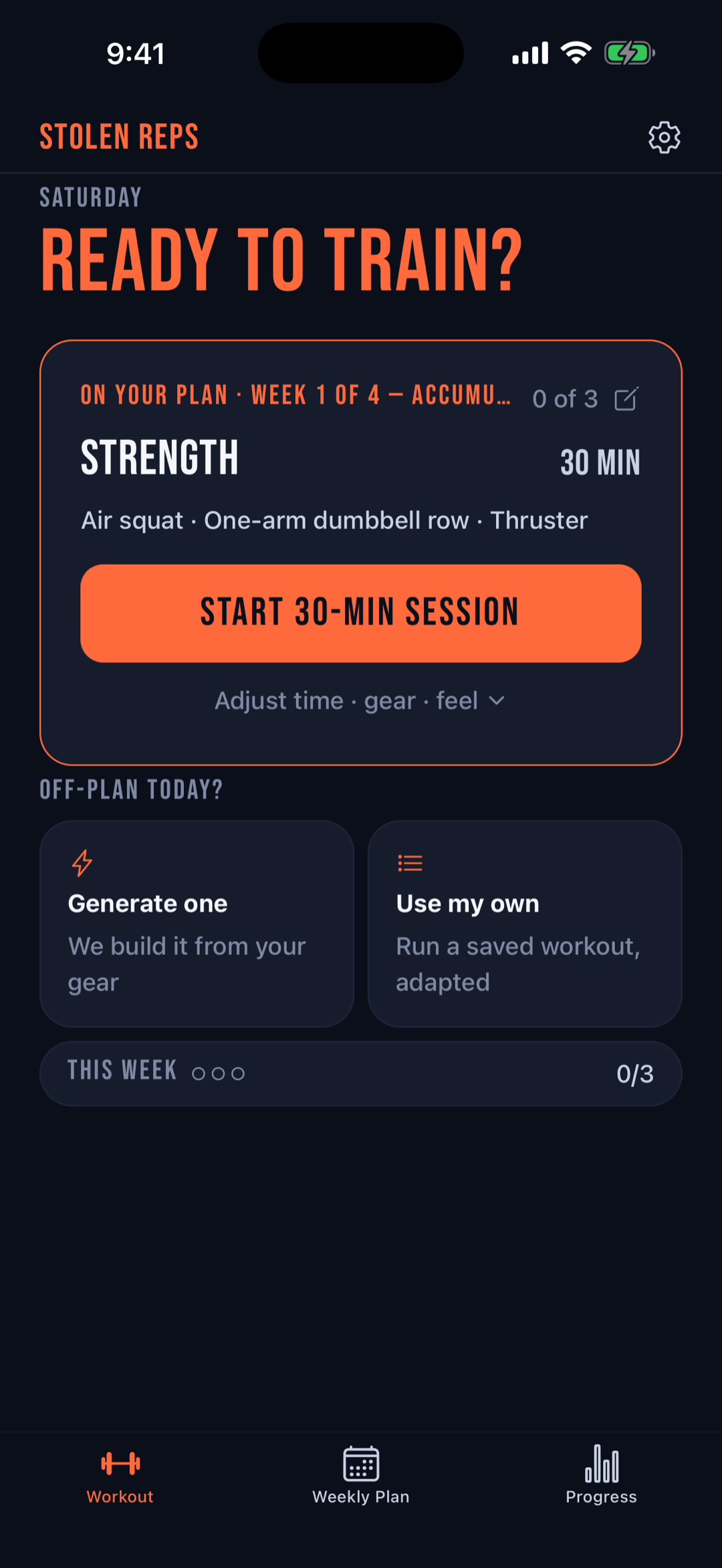
A realistic week for a busy dad
Monday, 8:45pm (30 min): Strength, back squat + row superset, overhead press. Wednesday, 7am (15 min): quick bodyweight session before the kids wake: quiet mode, no jumping. Saturday (45 min): the full garage session. Three workouts banked, and the app counted all of them toward the same weekly plan.
The three windows most dads actually get
The "one clean hour at the gym" that most programs are written for barely exists once you have young kids. In practice, training time shows up as three kinds of window, and a system that works has to handle all three:
- The scrap (10–20 min). Before a call, between naps, the gap before dinner. Too short for a "real" workout on paper, but plenty for a dense, superset-paired session that hits the main patterns. Most weeks are carried by these.
- The evening (25–35 min). After bedtime, tired but free. The trap here is spending ten of those minutes deciding — which is exactly the friction an adaptive generator removes. Tap 30, get a full strength or bodybuilding session, start.
- The rare hour (45–60 min). A quiet Saturday morning. The one time you can add volume and accessory work — and the app expands the same training intent to fill it instead of leaving you to improvise.
The point isn't to hold out for the rare hour. It's to train in whatever window you're actually handed, and let all three count toward the same week.
Why "just be more disciplined" is the wrong advice
Dads who fall off training rarely lack willpower — they burn it in the wrong place. Every skipped session usually started with a small decision that didn't get made: which workout, how long, which lifts, is 22 minutes even worth it. Decision fatigue is real, and by 9pm after work and bedtime, the tank is empty. That's the moment a rigid program asks the most of you: pull up the spreadsheet, figure out where you are in the block, adapt it to the time you actually have. Most people just close the app.
The fix isn't more discipline, it's removing the decision. When opening the app and tapping your available minutes produces a complete, correctly-scaled session in seconds, there's nothing left to negotiate with yourself about. You spend your willpower on the reps, not on the planning. Minimum-effective-dose research points the same direction: short, consistent training beats occasional long sessions, so the system that gets you started most reliably wins.
How time-scaling actually works
"Adaptive" is easy to claim and rarely real. In Stolen Reps, the time you pick isn't a label — it drives a real time budget. Every session is allocated across a warm-up, the main work, and a core finisher, and that budget shrinks or grows with your window. Pick 15 minutes and the app trims to the highest-value work and pairs opposing lifts into supersets so you waste no time standing around; pick 45 and it opens up more volume and adds accessory work. The intent of the session stays the same; the density changes.
That's the difference between a workout that "fits" your time and one that just gets cut off when the timer runs out. A 15-minute strength day isn't half a workout — it's a complete, coherent session designed for 15 minutes. See the 20-minute dumbbell session for a concrete example of a short window done right.
How the plan flexes when the week falls apart
The most common way a program dies is a calendar. It tells you leg day is Tuesday, you miss Tuesday because a kid spiked a fever, and now you're "behind" — a guilt debt you never pay back. That's the core of the program-versus-generator question: a program is written before it knows what your week looks like. A plan built for real life works differently: you set a weekly target — say three sessions — and complete them in any order, on any days that open up. Miss a day and nothing turns red. The week simply reshapes around what's left.
Stolen Reps' plan engine tracks the week as a target, not a fixed schedule, and advances you through a training block as you actually complete work — so progression is earned by what you did, not punished by what you missed. If a whole week gets swallowed, you can ease the plan down instead of abandoning it. The bar to clear is "did I train," not "did I hit every scheduled slot."
Training around interruptions
A dad's workout gets paused. Someone needs a snack, a diaper, a referee. The session that survives is the one you can walk away from and come back to without losing your place. Because Stolen Reps logs set by set and anchors its timer to the wall clock, stepping away mid-session doesn't reset anything — your progress is saved as you go, and the timer picks up where real time actually is when you come back, not where it was when you got pulled away. If a move isn't working for the day, you can swap it for an equipment-matched alternative on the spot rather than abandoning the whole workout.
This is quietly one of the biggest differentiators. A lot of one-star reviews of popular apps are people who lost an in-progress session to a crash or a sync failure and "wasted their workout window fighting the app." Local-first logging that never phones home is the direct answer — your session lives on your device and isn't waiting on a server to save it.
Quiet training when the house is asleep
The best window is often the one where everyone else is unconscious — early morning or right after bedtime — and the fastest way to blow it is a set of jumping burpees over a sleeping baby's room. Quiet options matter more than they sound: bodyweight strength, controlled tempo work, and low-impact conditioning keep the intensity without the thud. A nap-time session can be a genuinely hard 20 minutes and still not wake the house. When you pick a style and a window, you can steer toward the quiet, floor-based work that fits a sleeping home.
Common questions from dads
Is 15–20 minutes actually enough? For staying strong and consistent as a busy parent, yes — a short session done four times a week beats a perfect hour you keep postponing. The app is built around that trade deliberately.
Do I need a gym or a rack full of gear? No. The workout is generated from whatever you own — a single pair of dumbbells, a kettlebell, bands, or nothing at all.
I'm coming back after years off — will it throw me in the deep end? No. The app tunes volume, rest, and set count to your experience level, and can work around a nagging joint if you tell it about one, so "beginner" doesn't mean fifty burpees. You set how hard the ramp is; it doesn't assume you're 22 and fresh.
Will it nag me or bill me by surprise? No account, no login, works offline, and your data stays on your device. There's no questionnaire-then-paywall bait-and-switch and nothing quietly auto-renewing in the background.
Related: the 20-minute dumbbell workout · a plan that survives missed days · training during nap time · the workout generator by equipment.